
Coffee County Supervision Types
Parole and probation can both place rules on a released person, but they begin in different ways. The Georgia State Board of Pardons and Paroles decides whether an eligible state prisoner will be paroled. The Georgia Department of Community Supervision, or DCS, then handles field supervision. A judge orders probation as part of a sentence. DCS supervises adult felony probation in Georgia, while a misdemeanor case may use a local probation provider or court record. A bond release before trial is neither parole nor probation unless a separate sentence or supervision order applies.
Coffee Correctional Institution adds a key local distinction. A person leaving that state prison may enter parole and report to the office tied to an approved release plan. Someone leaving Coffee County Jail after posting bond may have no post-release sentence at all. The jail release record answers when county custody ended. The court, Parole Board, and DCS answer what came next.
| Point | Parole | Probation |
|---|---|---|
| How it starts | Parole Board release from a state-prison sentence | Court sentence served in whole or part in the community |
| Main record source | Parolee Search, TPM records, and Board notices | Sentencing court and DCS for felony supervision |
| Local field agency | DCS office assigned by residence and release plan | DCS for felony probation; court path may apply for misdemeanors |
| How it ends | Expiration or discharge shown in parole records | Completion, discharge, or court action on the probation term |
- Parole
- Conditional community release during a state-prison sentence.
- Probation
- A court-ordered sentence served under stated rules in the community.
- Discharge
- The formal end of a supervision term or sentence obligation.
- Absconder
- A supervised person alleged to have stopped reporting or left supervision without approval.
Check Coffee County Supervision
The anchor question is simple: is a released Coffee County person on parole or probation, and how can that status be verified? Start with the custody type. The Georgia Parolee Search is the direct official route for a person already on parole. Results may include parole begin and end dates, the parole office and office number, primary offense, and other Parole Board data. It is not a Coffee County Jail roster and does not list every person released on bond or after a short jail term.
The court sentence is the sound source for probation. DCS handles felony probation and parole, but a misdemeanor sentence may remain with the local court or its probation channel. A person whose case is still pending may be under bond rules without being on either parole or probation. The complete Coffee County released inmate search helps separate the jail release record from later supervision records.
- Identify whether the person left Coffee County Jail, Coffee Correctional Institution, or another system.
- Search the official Parolee Search by first and last name for an active or prior parole record.
- For probation, check the sentencing court and then DCS when the sentence is a Georgia felony case.
- Compare the begin date, end date, offense, and assigned office with the correct person.
- Contact the listed field office when the online result needs an official explanation or current assignment check.
Absence from Parolee Search does not prove that all supervision ended. The person may be on probation, supervised outside Georgia, assigned under another name form, or outside the search's scope. Confirm the sentence and agency before drawing a conclusion.
Note: A current jail roster shows custody, while a parole or probation record shows supervision after a qualifying release or sentence.
Coffee County Parole Decisions
A Tentative Parole Month, often called a TPM, belongs to the pre-release decision path. The Inmate TPM Lookup accepts a six-digit inmate number, GDC ID, or personal data. A TPM is not a release order. It marks a planned month for final review, after which the Board may set a date, postpone action, deny release, or change a prior decision. Conduct, required programs, and new facts can all affect the outcome.
The Board's parole process explains that eligible non-life cases may receive a TPM or a denial. Georgia law does not turn every sentence into the same release formula. General eligibility under O.C.G.A. 42-9-45 has exceptions, while O.C.G.A. 17-10-6.1 imposes special rules for serious violent felonies. A Coffee Correctional inmate with a TPM is still in prison until the Board completes review and a lawful release occurs.
The official TPM explanation is shown below. Its distinction between a tentative month and a final decision is the key point when reading Coffee County parole records.
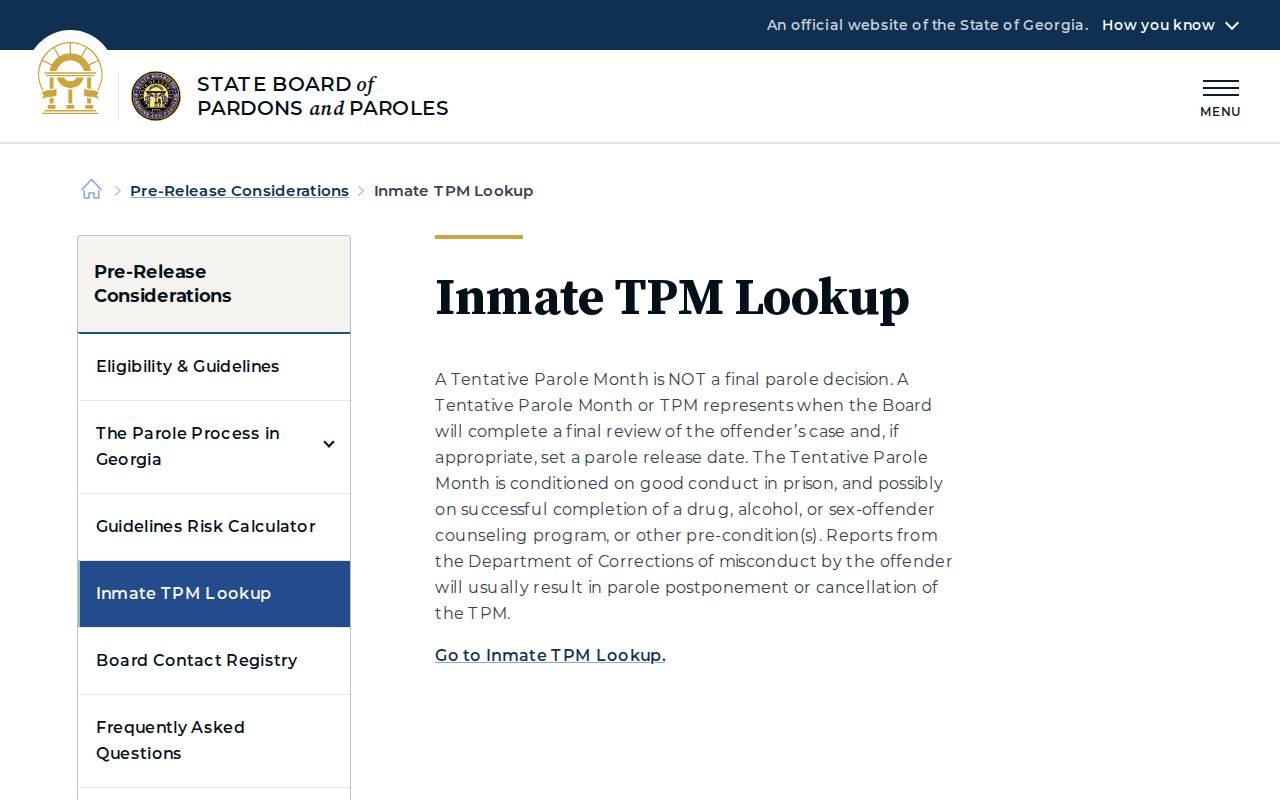
The image supports a cautious reading: use the TPM for planning, then confirm the actual parole release through the Board, GDC, and DCS records.
Coffee County Parole Meetings
The Parole Board posts monthly meeting notices, agendas, and cancellation notices. Those public meetings deal with policy and agency operations. Individual offender cases are not discussed there, and parole decisions are not made as a public court-calendar event. That difference matters when someone searches for a Coffee County parole hearing date. There is no researched statewide list that publishes every ordinary offender decision by meeting date.
Use the TPM lookup for a person who remains in state prison and Parolee Search for someone already released to parole. Board notices are still useful for understanding public meeting cadence and agency changes, but they do not replace a person-specific result. A decision may be set, denied, deferred, postponed, canceled, rescinded, or later converted into a final release date as the underlying record develops.
The Board notice page provides the public calendar layer.
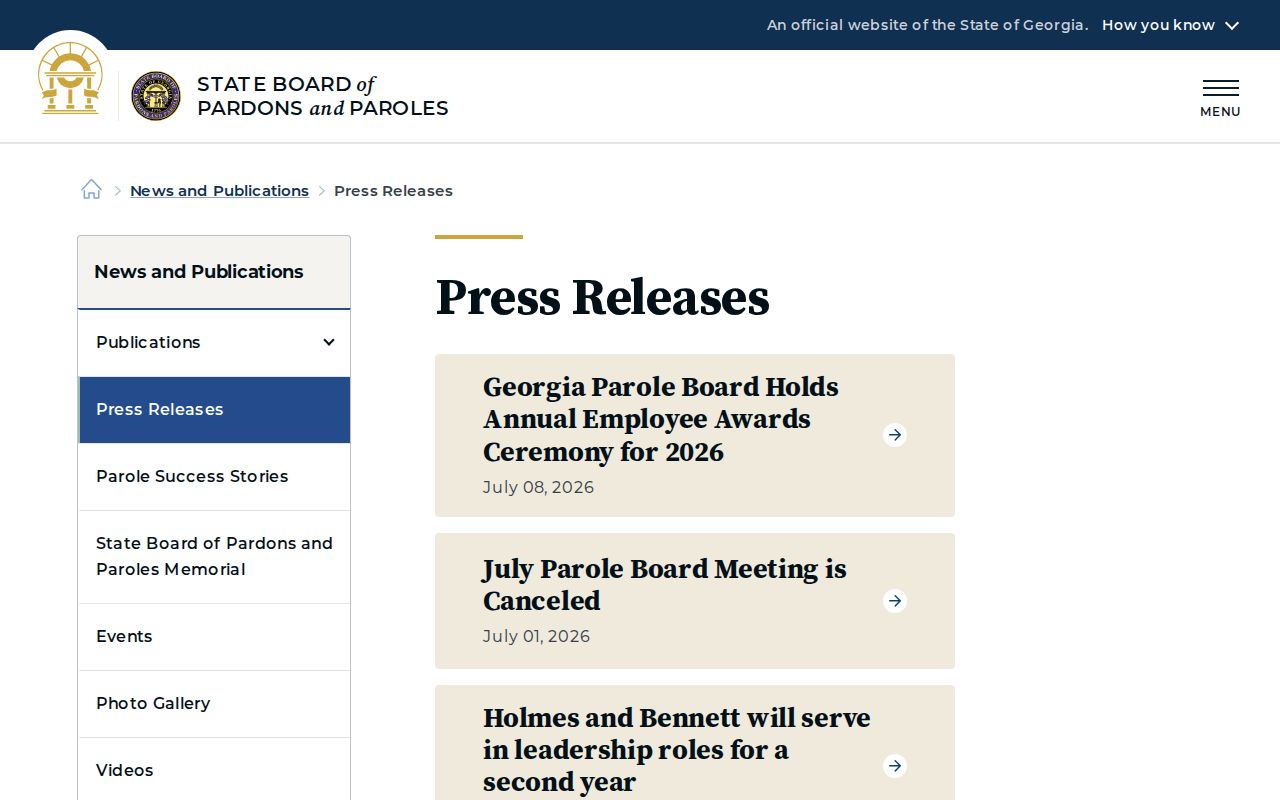
That page should be read as a policy calendar, not as an individual Coffee County parole docket.
Note: A monthly public Board meeting does not mean a named Coffee County offender's case will be heard or decided there.
Coffee County DCS Office
The DCS Douglas field office is the local post-release supervision contact documented for Coffee County. It serves Bacon and Coffee counties and the Waycross Circuit. Field staff supervise assigned felony probationers and parolees. The assigned office follows the person's residence, approved release plan, and case assignment, so someone released from Coffee Correctional Institution may report elsewhere.
Georgia DCS Douglas Field Office
319 E. Ward St.
Douglas, GA 31533
Monday-Friday, 8:00 a.m.-4:30 p.m.
State DCS main phone: (678) 783-4337
The official office page is pictured below.
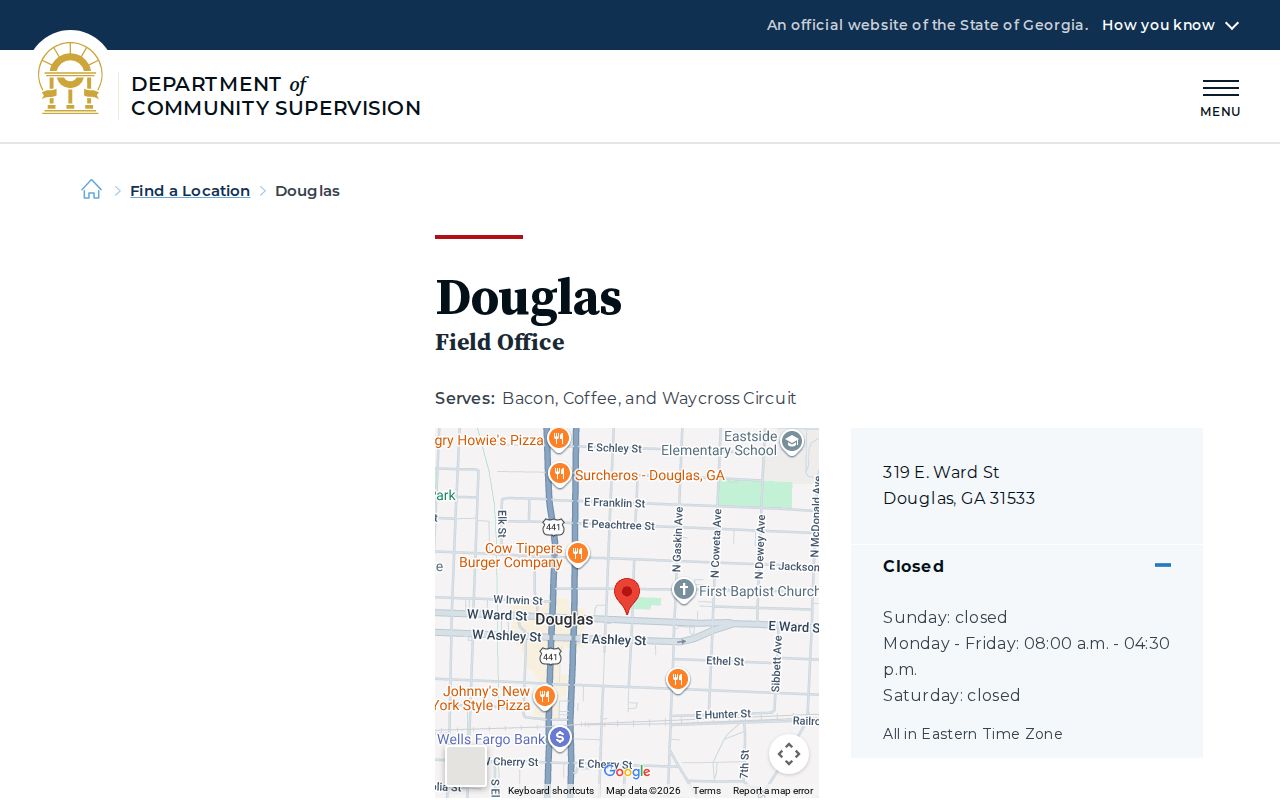
The office listing gives Coffee County a local verification point, while the statewide search tools remain the first place to identify the right record.
Coffee County Supervision Warrants
A released person can later appear in a warrant source without appearing in a live jail roster. Coffee County publishes active warrants and a wanted list with WANTED, CAPTURED, and RESOLVED labels. These sources may reflect a failure to appear, an alleged supervision violation, or another warrant basis. They are not a list of probationers or parolees.
An absconder is a person alleged to have stopped reporting or left supervision without approval. That status is not the same as a court finding, current custody, or a completed revocation. A warrant can lead to arrest, and CAPTURED or RESOLVED does not by itself explain the case outcome. Georgia's warrant guidance directs county-specific questions to the local sheriff and advises using reliable identifying details.
Important: Verify a warrant with the Coffee County Sheriff's Office. Do not treat a wanted-page label as proof of current jail custody or final supervision action.
Coffee County Release Documents
Coffee County's jail FAQ gives an unusual local detail about identity and transaction documents during custody. Birth certificates, Social Security cards, driver's licenses, alien registration cards, welfare cards, medical cards, school diplomas, and personal identification cards are treated as business or transactional documents. The FAQ says they are mailed directly to the facility and coordinated by the Business Office or its designee, while personal mail follows a separate central-processing route.
That policy matters when post-release reporting depends on records that were sent to the jail or need to be traced after custody. The jail handles property and document questions tied to the jail stay. DCS handles supervision instructions. A court handles an order or sentence. Keeping those roles separate prevents a call to the supervision office from being mistaken for a request about jail-held papers.
Note: Ask the office that handled the document or order, since DCS, the jail, and the court keep different records.
Coffee County Supervision Discharge
Supervision ends through expiration, formal discharge, or another authorized agency or court action. The parole begin and end dates in Parolee Search help frame the term, but an old date should be checked against the latest Board or DCS record. Probation completion belongs to the sentencing court and, for felony supervision, DCS. A revocation, tolling event, new order, or transfer of supervision can change what a simple date appears to mean.
Discharge from supervision is not the same event as release from jail or prison. The custody release may occur first, followed by months or years under conditions. When the term is complete, request the final record from the office that owned it. The sheriff can confirm the Coffee County Jail release event, the Parole Board can confirm parole action, DCS can address field supervision, and the court can confirm probation disposition.