
Coffee County Release Date Types
A projected or scheduled date is a planning field. An actual release date is the historical event when a person left a named agency's custody. The two may differ. Coffee County Jail can release a person on bond, under a court order, after time served, at sentence completion, or by transfer to another agency. A transfer date ends county jail custody but does not mean the person returned to the community.
State-prison records use more exact terms. Under Georgia Rule 125-2-4, the sentence begin date accounts for the sentence start, jail credit when allowed, and special court instructions. The sentence end date reflects the maximum term with non-running time and earned credits. The maximum release date is the full-service date without a parole decision. A tentative parole month, or TPM, is a planned year and month set by the Parole Board for possible parole placement.
Scheduled versus actual: A TPM or maximum release date helps frame timing, but only the final agency record confirms that release occurred.
| Record term | What it means | Who controls it |
|---|---|---|
| Bond or court-order timing | Release follows a valid order, checks, and jail processing | Court and Coffee County Jail |
| Maximum release date | Full-service GDC release date, apart from parole | GDC sentence computation |
| Tentative parole month | Planned month for possible parole after final review | Georgia Parole Board |
| Actual release date | Date custody ended at the named facility or agency | Releasing agency record |
Find Coffee County Release Dates
The best route depends on where the person is held. The Coffee County Sheriff's official public route is framed as an in-custody search, so it may not show a future date or a person who has already left. For a county jail sentence, request the booking and release record and compare it with the court order. For a state prisoner, begin with the GDC Find an Offender page and the direct GDC offender query. GDC says the tool can provide facility location, charges, and release date information.
- Confirm whether the person is at Coffee County Jail, Coffee Correctional Institution, another GDC prison, or another system.
- For county custody, check the current sheriff channel, then ask the jail or court about bond, sentence, credit, orders, and holds.
- For state custody, search GDC by full name, GDC ID, or case number and compare age, charges, and facility.
- Check the Parole Board TPM lookup when parole planning applies, keeping a TPM separate from a final release date.
- Near the expected date, confirm the result with the jail, GDC records, the court, or the Parole Board as appropriate.
GDC warns that public search information may be incomplete and directs written verification to Inmate Records and Information, PO Box 1529, Forsyth, GA 31029. That fallback matters when a date affects travel, family plans, or a court process. The full Coffee County released inmate lookup explains how to confirm the release after the person leaves custody.
Note: A missing person in a live roster does not establish release, because transfer and other-custody paths can also remove a listing.
Coffee County GDC Date Fields
Coffee Correctional Institution is in Nicholls, but it is a state-prison facility under GDC contract, not the Coffee County Jail. That makes the GDC search especially relevant in this county. Search by a full legal name first. If matches are broad, use a GDC ID or case number, then compare age, race, sex, charges, and facility. A photo may display when available, but identity should never rest on the image or name alone.
The official GDC landing page is shown below.
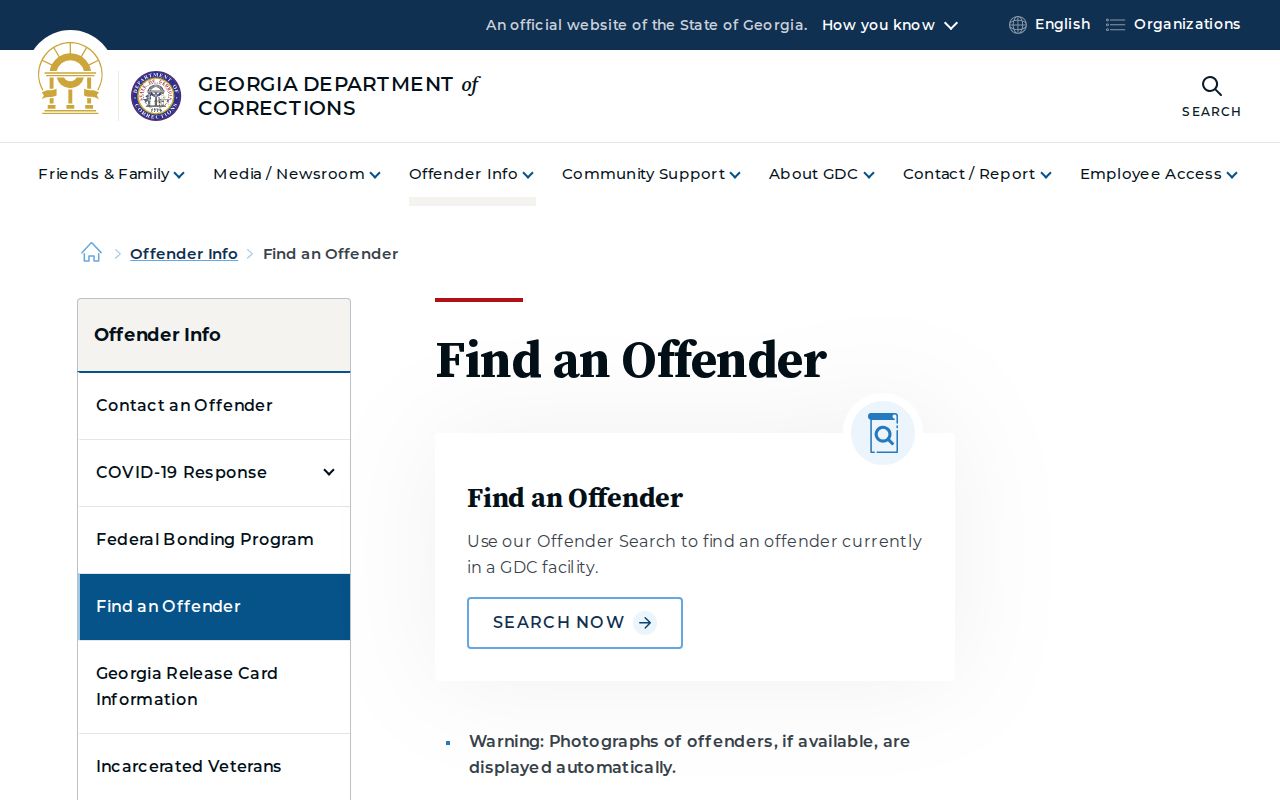
The screenshot marks the correct state source for Coffee Correctional and other GDC prisoners. It is not the source for an ordinary Coffee County Jail bond release.
| Search item | How it helps |
|---|---|
| Name | Starts a broad match for the state-prison record |
| GDC ID | Narrows the result to a known corrections identity |
| Case number | Links the search to a known case when supported |
| Age and descriptors | Separates people with similar names |
| Facility and charges | Checks that the result fits the known custody path |
| Release date | Provides the displayed state date, subject to verification |
Coffee County Parole Date Terms
Georgia's split between a maximum release date and a tentative parole month is the main release-date quirk. The maximum date assumes the whole GDC term is served without parole. The TPM is a Parole Board planning field. The Board's TPM explanation states that the month is not a final parole decision and does not guarantee release. Final review may still account for conduct, required programs, discipline, or new information.
The TPM lookup can use a six-digit inmate number, a GDC ID, or personal data. A result that shows a TPM should be described as tentative. It should not be repeated as the date someone will leave Coffee Correctional. If the Board later grants parole and sets a final date, the parole record and then the actual GDC release event become the stronger sources.
Parole is also distinct from discharge. Release on parole starts community supervision; discharge ends that supervision. The dates may be far apart, and the DCS office assignment can follow the person's approved residence rather than the county where the prison sits.
Coffee County Release Date Credits
Georgia does not support a flat claim that every inmate serves the same share of a sentence. Serious violent felony rules under O.C.G.A. 17-10-6.1, general parole eligibility rules, recidivist provisions, life-sentence rules, and Parole Board judgment all affect eligibility. Sentence type and offense matter. So do court credit, discipline, program requirements, and holds. A universal percentage would blur those differences.
For eligible GDC offenders, Performance Incentive Credit, or PIC, may provide opportunities to reduce length of stay. GDC ties PIC to satisfactory progress in education, vocational work, treatment, work assignments, and good conduct through a point system. The Parole Board may revisit eligibility when new information appears. PIC is not a promised county jail good-time award.
The GDC PIC page documents this state-prison program.
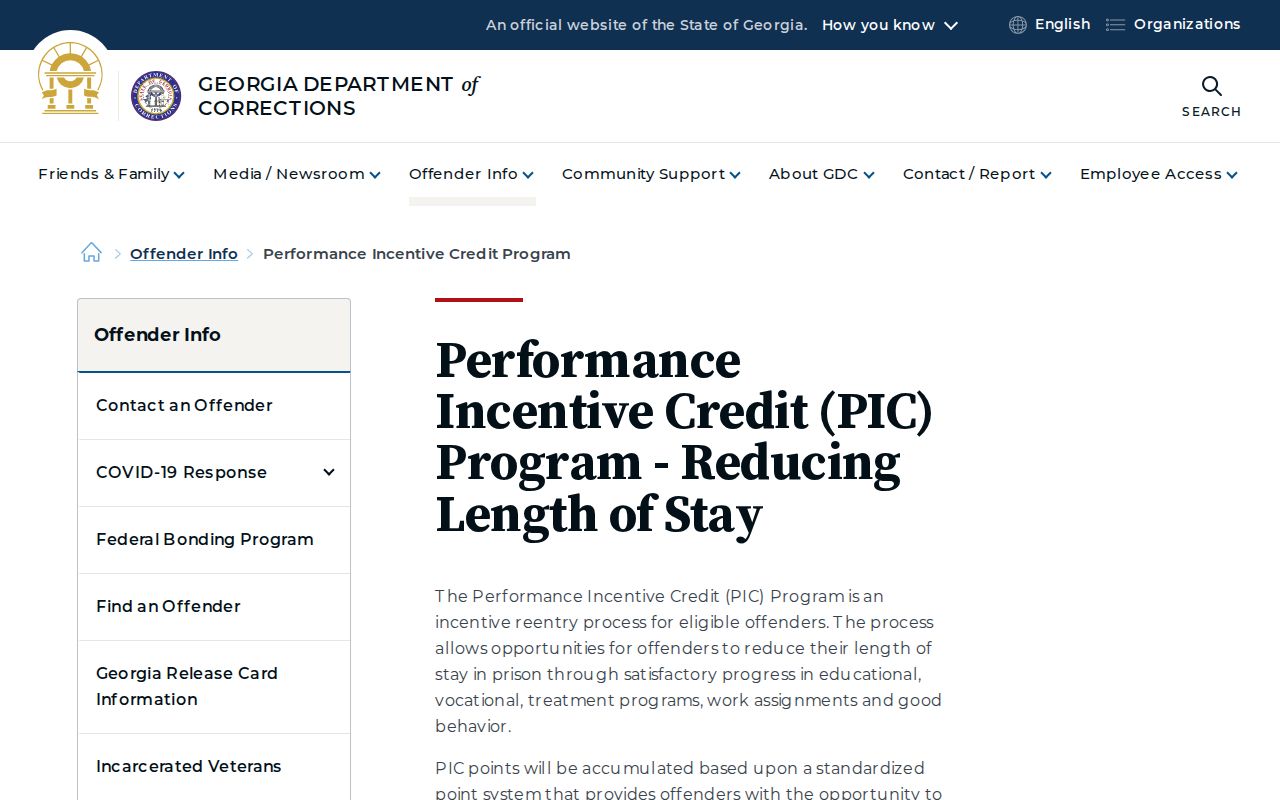
The program page shows why earned progress belongs in a GDC calculation, not in an invented Coffee County Jail formula.
Note: PIC can affect eligible state-prison time, but it does not create a guaranteed date or a public county-jail calculator.
Coffee County Jail Release Timing
No researched Coffee County source states a county jail good-time formula, weekend-release rule, or public date calculator. County jail timing must therefore stay tied to the actual record. A pretrial detainee has no sentence-based date. Release may follow bond approval, a judge's order, dismissal, or another lawful event. Even after the legal basis exists, staff may need to validate paperwork, check warrants and holds, process property, and arrange a transfer.
For time served or a short sentence, the jail works from the court order, sentence, and credited time. If the record says GDC pickup, USMS pickup, ICE hold, or transfer to another jail, the Coffee County release date marks the end of county custody. It does not mark freedom from all custody. The receiving agency controls the next status and any later date.
Pretrial timing: Do not calculate a release date from the arrest date. Bond, court action, holds, and jail processing control the next step.
Coffee County Dates Can Change
A projected date is built from records that can be corrected or changed. Missing jail credit may require review by the prison counselor, a grievance, and contact with the clerk of the county of conviction. A detainer is a request or notice from another agency that may keep custody in place or cause transfer. Non-running time is a period the sentence rules do not count in the usual way. Each can move the displayed result.
| Factor | Possible effect | Verification source |
|---|---|---|
| Jail credit correction | Changes the computed sentence begin or end | GDC and sentencing court clerk |
| Discipline | Can affect credits, programs, or parole review | GDC and Parole Board |
| Program completion | May satisfy a parole condition or PIC factor | GDC and Parole Board |
| Detainer or hold | May delay community release or cause transfer | Holding and receiving agencies |
| Court order | Can correct or alter the sentence record | Sentencing court |
| Parole action | May set, postpone, deny, or rescind a planned release | Parole Board |
Confirm Coffee County Release Dates
Check again as the expected date approaches. For Coffee County Jail, use the jail record and the court order. For Coffee Correctional or another state prison, use GDC, the Parole Board, and written records verification. Georgia VINE can add a custody-change alert for a covered person, but an alert is not a certified release record. Instructions are available through the VINE Inmate Check.
Keep the question narrow when contacting an office. Ask whether the displayed field is a maximum release date, TPM, parole date, transfer date, or actual release. Then ask which agency holds the final record. That small distinction prevents a projected month from being mistaken for a completed release.
A date dispute also needs the right paper trail. If a GDC inmate believes jail credit is missing or the sentence was computed from an incorrect court record, GDC directs the person to speak with a counselor and use the grievance process when the issue is not resolved. The clerk in the county of conviction may need to confirm the sentencing order or credit documentation. Coffee County Jail staff cannot revise a state sentence merely because the person once spent time in local custody.
After the expected day passes, look for an actual release or transfer entry rather than repeating the old forecast. A state record may show parole, full-service release, or movement to another facility. A county record may show bond, time served, a court order, or pickup by another agency. Each result changes the next call. The releasing agency confirms its own event, while the receiving agency confirms any custody that followed.
Note: Keep copies of the displayed date and later agency response so a changed estimate can be traced to the correct record.